

Key performance indicators
The key management indicators of BLG LOGISTICS that we apply throughout the Group form the basis for our operational and strategic management decisions. We use them to set targets, measure the company’s performance and determine the variable remuneration of managerial staff and employees not covered by collective wage agreements among other factors.
The core management indicator metrics are:
Revenue
Combined Group revenue is derived from the combined statement of profit or loss and other comprehensive income and does not include the revenue of the CONTAINER Division.
EBIT
On account of the significant contribution of the CONTAINER Division to earnings, income from equity investments is included in EBIT.
Earnings before income and taxes (EBIT) is calculated at BLG LOGISTICS as follows:
- Revenue
- Other income
- Cost of materials
- Personnel expenses
- Depreciation, amortization and impairment
- Other expenses
- Result from equity interests
EBT
Earnings before taxes (EBT) form the basis for determining profitability independently of tax effects that cannot be influenced.
It is also suitable for measuring profitability in an international comparison.
EBT margin
EBT divided by revenue yields the EBT margin, which is an indicator of a company’s efficiency and profitability.
RoCE
Return on capital employed (RoCE) is a key indicator that measures how efficiently and profitably a company uses its capital. It is calculated by dividing EBIT by the capital employed. Capital employed at BLG LOGISTICS includes the following components:
- Non-current assets (incl. financial assets)
- Inventories
- Trade receivables
- Trade payables
The key performance indicators revenue, EBIT, EBT and EBT margin are also determined within the scope of both internal monthly reporting and corporate planning and forecasts. RoCE is only reported on a Group-wide basis and will only be included in monthly reporting moving forward.
In addition to the metrics noted above, the variable remuneration of the Board of Management and, from the 2023 financial year, of employees not covered by collective wage agreements, is also measured against the targets for carbon emissions, the reduction of work-related accidents compared to the previous year and the share of trainees in the total workforce. The other financial and non-financial key performance indicators consist of individual management variables depending on the operating business unit. This includes measurement variables such as vehicle handling, processed quantities, energy consumption and container handling. To assess future developments, the company relies on a continuous dialog with customers and closely monitors overall economic developments in order to react to changes in a timely manner.
In 2023, BLG LOGISTICS defined ten quantitative sustainability targets. Starting in the 2026 financial year, these will be supplemented by an additional target – the health rate. These 10+1 quantitative targets make it possible to track and manage progress in our key areas of action at an operational level and serve as a guide for forward-looking sustainability management. You can find more information in the chapter “Non-financial statement”.
For explanations regarding the key forecast financial performance indicators and the degree to which they were reached in the 2025 financial year, please refer to the Report on economic position. The forecast for the current year is explained in the Outlook.
Non-financial performance indicators
As an international seaport and logistics service provider, BLG LOGISTICS requires committed, motivated and skilled employees in order to be successful on the market over the long term and to meet the continuous challenges of globalization and demographic change. In order to attract, develop and retain its employees, BLG LOGISTICS aims to consistently maintain its image as an attractive company on the labor market. That is why our personnel policies include options for maintaining a work-life balance and specific health management mechanisms, as well as performance-related remuneration and targeted training opportunities.
The successful implementation of a clear and forward-looking strategy largely depends on the management of BLG LOGISTICS. Our leadership principles and our corporate values support us in achieving a shared understanding of leadership at all levels.
The distribution of persons across the segments pursuant to Section 267 (5) HGB (annual average headcount), excluding members of the Board of Management as well as apprentices and trainees, is shown in the table, broken down by division.
|
|
2025 |
|
2024 |
|
Change, percentage |
|---|---|---|---|---|---|---|
AUTOMOBILE Division |
|
2,970 |
|
2,926 |
|
1.5 |
of which blue-collar workers |
|
2,448 |
|
2,462 |
|
|
of which white-collar workers |
|
522 |
|
464 |
|
|
CONTRACT Division |
|
5,386 |
|
6,189 |
|
-13.0 |
of which blue-collar workers |
|
4,144 |
|
4,895 |
|
|
of which white-collar workers |
|
1,242 |
|
1,294 |
|
|
CONTAINER Division |
|
1,614 |
|
1,555 |
|
3.8 |
of which blue-collar workers |
|
1,128 |
|
1,082 |
|
|
of which white-collar workers |
|
486 |
|
473 |
|
|
Segment employees |
|
9,970 |
|
10,670 |
|
-6.6 |
of which blue-collar workers |
|
7,720 |
|
8,439 |
|
|
of which white-collar workers |
|
2,250 |
|
2,231 |
|
|
Central departments |
|
482 |
|
449 |
|
7.3 |
of which blue-collar workers |
|
0 |
|
0 |
|
|
of which white-collar workers |
|
482 |
|
449 |
|
|
Employees incl. CONTAINER Division |
|
10,452 |
|
11,119 |
|
-6.0 |
of which blue-collar workers |
|
7,720 |
|
8,439 |
|
|
of which white-collar workers |
|
2,732 |
|
2,680 |
|
|
Less employees in the CONTAINER Division |
|
-1,614 |
|
-1,555 |
|
3.8 |
of which blue-collar workers |
|
-1,128 |
|
-1,082 |
|
|
of which white-collar workers |
|
-486 |
|
-473 |
|
|
Employees of BLG LOGISTICS |
|
8,838 |
|
9,564 |
|
-7.6 |
of which blue-collar workers |
|
6,592 |
|
7,357 |
|
|
of which white-collar workers |
|
2,246 |
|
2,207 |
|
|
Employees 2025
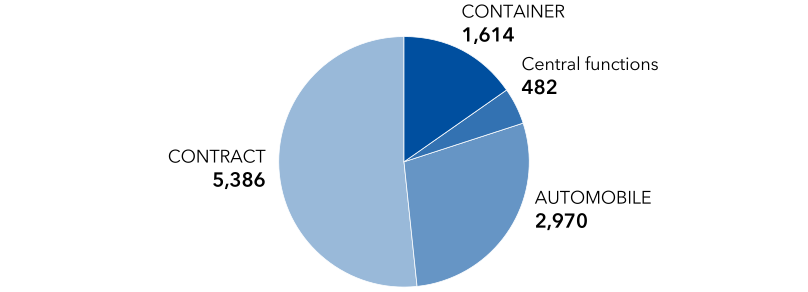
The average number of employees in the reporting year (excluding the CONTAINER Division) fell by 7.6 percent compared to the previous year. This decline is largely attributable to the CONTRACT Division. In particular, individual, expired businesses and in some cases low volumes due to the economic climate had an impact on personnel numbers.
Employees by age group
Employees by gender*
