

Our environmental responsibility also includes the responsible use of resources and waste management. With systematic waste management, we reduce negative impacts on the environment.
Management of impacts, risks and opportunities
An overview of the material impacts, risks and opportunities can be found in the chapter General information under Material impacts, risks and opportunities and disclosure requirements included in the Sustainability Statement (IRO-2).
Policies related to resource use and circular economy (E5-1)
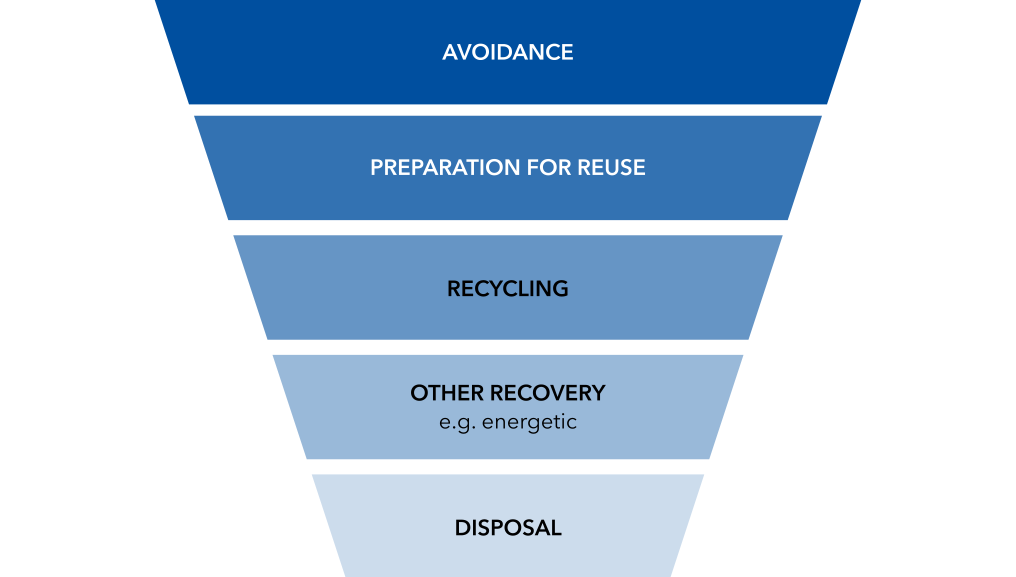
As a logistics service provider, BLG LOGISTICS generates different types of waste through the transport and storage of goods. In doing so, we follow the first avoid, then reduce, and then offset approach. To minimize our environmental impacts, we continuously improve our waste management and disposal processes, with a particular focus on the recording and management of waste volumes and valuable materials. Our approach, which is based on the waste hierarchy laid down in the German Circular Economy Act (Kreislaufwirtschaftsgesetz, KrWG), is part of our environmental and energy policy. This policy commits us to taking responsibility for using resources sustainably and sets clear, realistic targets, especially for the avoidance, reuse and recycling of recyclables and waste.
Five levels of waste hierarchy according to the Closed Substance Cycle Waste Management Act (KrWG)
Our environmental and energy policy is publicly available on our website www.blg-logistics.com/en/sustainability. Employees can also find it as a notice at the sites, in the employee app and in the central document library. Various work instructions refer to it. Further details on our environmental and energy policy can be found in chapter E1–Climate Change.
BLG LOGISTICS operates an environmental management system that has been certified in accordance with DIN EN ISO 14001 for over ten years and is currently implemented at a total of 36 automotive terminals and logistics sites in Germany. The management system provides the framework for our processes, responsibilities and the implementation of requirements related to environmental protection, especially in the area of waste management.
Actions and resources related to resource use and circular economy (E5-2)
Our sites ensure the separation, collection and disposal of recyclables and waste in accordance with the law. We primarily work with certified waste management service providers specializing in recycling, energy recovery and waste disposal.
All waste volumes and types are centrally and consistently recorded and documented. Responsibility for waste management lies with the Quality Regulatory Management department, supported by the Safety and Environmental Protection department. Processes are coordinated in close collaboration with the sites and the Quality Management units of the AUTOMOBILE and CONTRACT Divisions. At the site level, trained environmental management coordinators or waste officers are responsible for data collection and serve as points of contact for employees. In addition to compliance with the German Commercial Waste Ordinance (Gewerbeabfallverordnung, GewAbfV), we use a special management system module that is accessible to our employees at all times and provides clear information on processes and responsibilities.
At many sites, actions are already being implemented to reduce waste and improve reuse and recovery. Where possible, we use reusable packaging as a general principle. One example of effective waste management at certain sites is the recycling of styrofoam packaging, which we receive as a protective material for products and components. After unpacking, this material is compacted on site and resold rather than disposed of. We also compress wood waste at various locations to reduce the number of trips to the disposal site and the resulting emissions.
Metrics and targets
Targets related to resource use and circular economy (E5-3)
Field of action |
|
Target horizon and objective |
|
Status 2025 |
|
|
||||
|---|---|---|---|---|---|---|---|---|---|---|
Waste management |
|
Annually |
|
|
|
|
||||
|
||||||||||

 Pending
  In progress
  Target achieved
Germany’s target of an annual separate waste collection rate of at least 90 percent continued to apply in the reporting year. Detailed data on waste types and volumes for Germany is available for the reporting period. This level of data analysis will be further expanded at our fully consolidated international sites in the future. Data from South Africa for 2025 is already available in a format similar to that used in Germany.
At 88.6 percent, the target separate waste collection rate was again not achieved in 2025. However, the result improved by 3.3 percentage points compared with the previous year (85.3 percent). To identify root causes and potential barriers to achieving the target, hotspot analyses were conducted at the German sites. Initial actions have already been implemented or initiated, including the installation of additional recycling containers and renewed employee awareness efforts at site level.
Ongoing monitoring throughout the year will continue, as the target metric and associated results remain part of quarterly reporting to the Board of Management and senior executives. From 2026 onward, data from fully consolidated international sites will also be fully included. In addition, we will increase the level of detail in our data collection from 2026 in order to meet future mandatory reporting requirements.
Resource outflows/waste (E5-5)
A portion of waste arises when customers deliver goods to us in packaging, for which disposal is often our responsibility. At 10 of a total of 67 sites, however, full responsibility for waste disposal remains with the customer, meaning that we have no detailed information on volumes or disposal methods. These volumes are not included in our waste inventory. Relevant waste streams at BLG LOGISTICS include, for one thing, disposal of packaging waste (from incoming goods and returns), and for another, disposal of used vehicle parts from mechanical processing (tires, plastics, sheet metal, vehicle glass).
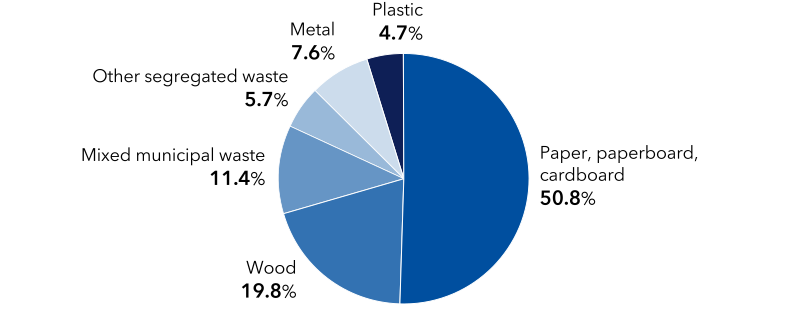
Overall, we were once again able to slightly reduce our waste volume compared to the previous year, to 16,271.26 tons. The largest categories (paper, paperboard and wood) remained at the previous year’s level and together account for just over 70 percent of all waste.
Percentage breakdown of total waste volume in 2025
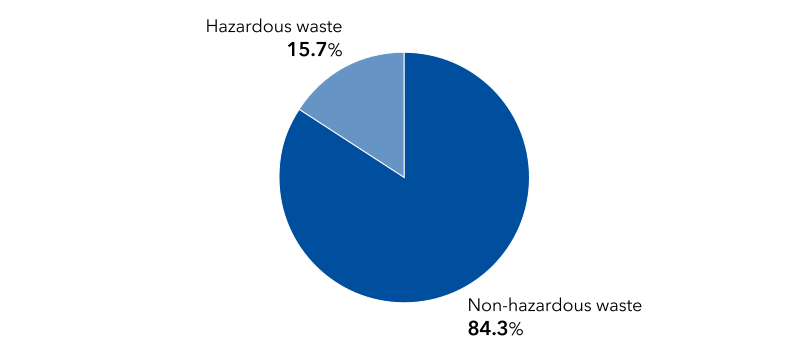
Hazardous waste accounted for approximately 15.7 percent of the total volume in 2025. BLG LOGISTICS does not generate radioactive waste. Generally, our hazardous waste consists of machine, gear and lubricating oils, absorbent and filter materials, and batteries. The absolute volume increased by 12.1 percentage points compared with the previous year. This increase is attributable to a one-off effect at AutoTerminal Bremerhaven, where extensive refurbishment work was carried out in the reporting year; 80.95 percent of hazardous waste can be attributed to this. In principle, the protection of people and the environment is the top priority when handling hazardous waste, as well as all other waste streams.
Percentage breakdown of non-hazardous waste in 2025
Starting in 2026, we will expand our waste data collection to include the information on waste treatment required under ESRS. In addition to volumes, we will report waste treatment by waste code in the following categories:
Recovery – Reuse
Recovery – Recycling, Reuse
Recovery – Other (including incineration with energy recovery)
Disposal – Incineration without energy recovery
Disposal – Landfill
Disposal – Other
Unknown
In doing so, we are not only aligning with future reporting requirements but also see this as an opportunity to identify further areas in our waste management system where we can operate in a more environmentally responsible manner.