

Risk categories and individual risks
From the risk types defined for BLG LOGISTICS, the material risks for BLG LOGISTICS by risk category are described in the following sections. In selecting materiality, risks are included that would have a noticeable effect on the company’s financial position, financial performance and cash flows if they were to occur. Furthermore, in line with the principle of dual materiality, the company draws on risk analyses to assess and manage the impacts of its business activities on people and the environment. Environment, Social and Governance (ESG) risks are considered an integral part of the risk categories described below. In principle, the assessment and derivation of measures is made on the basis of scenarios, taking into account all known influencing factors from opportunities and risks.
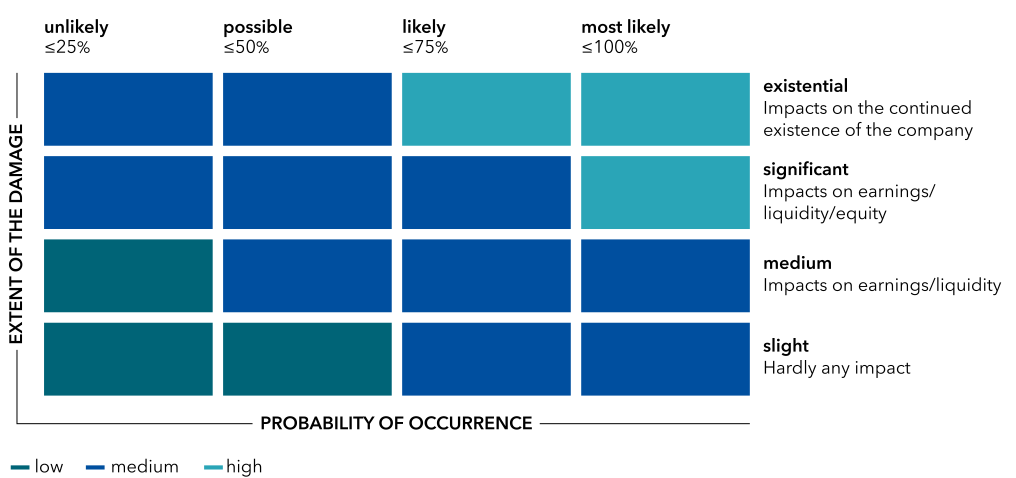
An overview of material risks is presented in the table.
Risk |
|
Potential damage |
|
Likelihood of occurrence |
|
Trend compared to previous year |
|---|---|---|---|---|---|---|
Strategic risks |
|
significant |
|
unlikely |
|
↗ |
Market risks |
|
existential |
|
possible |
|
↗ |
Political, legal and social risks |
|
medium |
|
possible |
|
↗ |
Service and infrastructure risks |
|
significant |
|
possible |
|
↗ |
Financial risks |
|
medium |
|
unlikely |
|
→ |
Risk matrix
Service and infrastructure risks
Risks from business relationships
In all operating business areas, close customer relationships and the sometimes demanding contract periods and conditions, especially with some major customers, make it necessary to monitor changes in economic trends and the demand and product life cycles especially closely.
Infrastructure capacity and security
Fluctuations in volumes or supply gaps affecting customers can lead to temporary capacity bottlenecks. We have actively searched the market and have found additional third-party indoor and outdoor capacity, which will be leased for a fee, if required.
In contrast, when there is lower usage of our in-house capacity, no short-term alternative usage is normally generated. This results in a negative effect arising from fixed costs for floor space and hall costs that are not covered by income. These risks are taken into account when drafting and calculating prices and contracts, including increasing the fixed remuneration component.
Indoor and outdoor facilities and transport and handling equipment are regularly serviced and repaired at fixed intervals. This ensures that we can provide services on an ongoing basis.
Should the planned measure to deepen the Outer Weser fail to materialize or be seriously delayed, this could have a highly adverse effect on the future development of transshipment at the Bremerhaven location.
Personnel risks
Demographic change is creating a shortage of qualified employees in many areas. Not being able to fill positions as and when needed or with the right qualifications following (unplanned/planned) fluctuation leads to increased reliance on external personnel and, consequently, to higher costs and/or lower productivity. At the same time, this puts additional strain on the workforce, possibly resulting in increased absenteeism, accidents and further fluctuation.
In order to reduce the number of people leaving the company, we specifically invest in the skills of our employees and senior executives and update feedback channels to enhance the line of dialog between employees and top management. Employee retention is promoted through targeted personnel development measures, strong leadership and transparent remuneration systems that foster trust and satisfaction.
The HR organization was restructured in order to boost the effectiveness of the recruitment process. A central recruiting department pools the necessary knowledge to ensure that the application process is efficient and targeted. In addition, BLG LOGISTICS identifies key positions and develops comprehensive talent management to secure important competencies in the company and actively address future challenges. These measures ensure that BLG LOGISTICS also has qualified personnel in the long term and is perceived as an attractive employer.
Environmental risk
The increasing frequency and intensity of acute extreme weather events (for example heatwaves, storms, flooding), combined with the longer-term chronic changes in the mean values and fluctuation ranges of various climate variables (e.g., temperature, precipitation, sea level) pose threats to the company’s assets and business processes. Various natural hazard scenarios for our property, plant and equipment, as well as the potential operating downtimes associated with them, were analyzed.
To transfer the risk of consequential losses, BLG LOGISTICS has taken out property damage and business interruption insurance. Individual theoretical risks such as a storm surge currently cannot be fully insured. An expanded climate vulnerability analysis is currently being conducted as part of preparations for regulatory requirements (CSRD, EU Taxonomy). The potential risks identified in this process are incorporated into site analysis as part of the company’s business continuity management and are assessed accordingly.
IT risks
The number of cyber incidents, such as IT outages, ransomware attacks and data breaches, remained high in 2025.
As information security plays a central role in the company’s business processes, this risk remains significant for BLG LOGISTICS. BLG LOGISTICS has introduced various measures to avoid and mitigate risks. Processes and technologies are continuously reviewed.
Raising employees’ awareness of the importance of sensitive handling of all business-relevant information is something the company takes very seriously. The company therefore conducts internal communication and training campaigns, and ensures that appropriate technical support is in place to guarantee the confidentiality, integrity and availability of information at all times.
In 2025, the emergency processes were reviewed and a crisis team with appropriate decision-making powers was established to implement clearly defined processes ensuring a quick and efficient response in the event of a potential attack.
Together with the data protection officers, the company ensures that personal data is processed exclusively in accordance with the regulations of the EU General Data Protection Regulation and the respective applicable local laws.
Financial risks
Credit risk
The Group’s credit risk mainly results from trade receivables and lease receivables. The amounts shown in the combined statement of financial position do not include allowances for expected credit losses. Owing to the ongoing monitoring of receivables at management level and the use of commercial credit insurance depending on customer creditworthiness, BLG LOGISTICS does not consider itself exposed to any significant credit risk.
The credit risk in respect of cash and derivative financial instruments is limited because these are currently held exclusively at banks that have been awarded high credit ratings by international rating agencies, which are highly secure thanks to a joint liability scheme and/or at which there are offsetting opportunities through non-current loans.
The maximum credit risk of the Group is represented by the carrying amounts of the financial assets recognized in the statement of financial position (including derivative financial instruments with positive market value). The Group is also exposed to a liability risk through the assumption of financial guarantees, which as of the reporting date was considered to be low risk.
As of the reporting date, there were no further significant credit risk mitigation agreements or hedges.
Counterparty risk
At present, BLG LOGISTICS invests excess liquidity in overnight funds at various banks. This gives rise to counterparty risk, as a potential default of one of these banks would result in a loss of liquidity.
The ratings issued by banks are reviewed on a regular basis to counteract any potential counterparty risk. At the same time, the company requires a defined minimum rating for an investment and allocates short-term investments to several banks.
Foreign currency risk
With very few exceptions, the Group companies operate in the eurozone and invoice only in euros. As a result, currency risk could only arise in isolated cases, such as in relation to foreign dividend income, loans granted in foreign currency as part of group financing, or the purchase of goods and services from abroad.
Liquidity risk
Liquidity risks may arise from payment bottlenecks and the resulting higher financing costs. The Group’s liquidity is ensured by central cash management at the level of BLG KG.
All significant subsidiaries are included in cash management. Due to the centralized management of capital expenditure and liquidity management, financial resources (loans/leases) can be provided in good time to meet all payment requirements.
The Group’s liquidity needs are covered by cash and committed credit facilities. The issue of sustainability is also becoming increasingly important in the capital market. The definition of sustainability targets as part of the overall strategy, as well as the implementation of the corresponding measures, are increasingly in the focus of potential lenders and can be criteria for granting loans. The company’s sustainability measures therefore act as a factor in ensuring that we can meet our liquidity requirements in the future.
In parallel, the BLG Group uses the non-recourse sale of receivables under a factoring agreement as an off-balance-sheet financing instrument to further optimize the balance sheet structure. The obligations of the factor to purchase existing and future receivables are limited to a total maximum amount of EUR 75 million. BLG LOGISTICS is free to decide to what extent the revolving nominal volume is utilized. The risks material to disposal relate to the credit risk and the risk of late payment (late payment risk). The credit risk is transferred in full to the factor in return for payment of a factoring fee. There is no significant late payment risk. The receivables were therefore derecognized in full.
Interest rate risk
The interest rate risk which BLG LOGISTICS is exposed to arises primarily from non-current loans and other non-current financial liabilities. Interest rate risks are managed with a combination of fixed-interest and floating-interest loan capital. The majority of the liabilities to banks have been concluded for the long term or fixed interest rates have been agreed through to the end of the financing term, either originally as part of the loan agreements or through interest rate swaps which have been concluded within micro-hedges for individual floating-interest loans.
The increased requirements of banks in terms of creditworthiness and sustainability could put further pressure on the interest margin.
Interest rate risks are disclosed through sensitivity analyses in accordance with IFRS 7. These show the effects of changes in the market interest rate on interest payments; interest income and expense; other income items; and equity. The interest rate sensitivity analyses are based on the following assumptions.
With regard to non-derivative financial instruments with fixed interest rates, market interest rate changes are only recognized through profit or loss if these financial instruments are measured at fair value. All fixed-interest financial instruments measured at amortized cost are not subject to interest rate risks within the meaning of IFRS 7. This applies to all fixed-interest loan liabilities of BLG LOGISTICS, including lease liabilities and other financial loans. When hedging interest rate risks in the form of cash flow hedge-designated interest rate swaps, changes to the cash flows and to the contributions to earnings induced by changes to the market interest rate of the hedged primary financial instruments and the interest rate swaps balance each other out almost completely, effectively eliminating the interest rate risk.
Measuring hedging instruments at fair value through other comprehensive income has an effect on the hedging reserve in equity and is therefore taken into account in the equity-related sensitivity calculation. Changes in the market interest rate of non-derivative floating-interest financial instruments whose interest payments are not structured as hedged items as part of cash flow hedges against interest rate risks have an effect on net interest income (expense) and are therefore included in the calculation of income-related sensitivities. The same applies to interest payments from interest rate swaps which are, as an exception, not contained in a hedge accounting relationship in accordance with IFRS 9. In the case of these interest rate swaps, market interest rate changes also have an effect on the fair value and therefore affect the remeasurement of financial assets or financial liabilities to fair value and are therefore included in the income-related sensitivity analysis.
From today’s perspective, the likelihood of the financial risks described above arising at BLG LOGISTICS is estimated to be low.
Further disclosures on the management of financial risks can be found in note 32.
Political, legal and social risks
Legal and political environment
International trade policy and planning conditions remain highly uncertain in light of current US foreign and tariff policy, as well as trade relations between China and the EU. This weighs on imports and exports and intensifies competitive pressure, particularly from Chinese providers in the electric mobility sector.
At the same time, ongoing cost pressure on customers is delaying decisions on new logistics concepts and making planning more difficult. Structural challenges such as demographic change, the shortage of skilled labor in logistics and limited public investment in infrastructure and transformation are further dampening companies’ willingness to invest.
Contract risks
Contract risks result from the fact that the maturities of contracts with customers sometimes do not match those relating to property leasing.
Changes in the market environment can lead to deviations from the assumptions with regard to quantities and cost structure made in the price calculation. Any resulting deviations from projections are addressed within the scope of renegotiations.
Risk provisions have been recognized for risks from onerous contracts. The level of risk may increase significantly as a result of changes in circumstances over time. Based on our current estimation, a risk of this kind should be viewed as low.
Growing regulatory requirements
Over the coming years, BLG LOGISTICS along with its suppliers and customers, will continue to face new regulations and rules that not only constitute a heavy administrative burden, but that could also effectively restrict business activities. This includes repercussions from the implementation of the Supply Chain Act (LkSG), the CSDDD, the NIS 2 Directive, including in relation to the operational implementation.
By monitoring regulatory changes, BLG LOGISTICS reviews new requirements and ensures that any necessary adjustments to its own business processes are implemented early on.
Strategic risks
Risks from acquisitions and investments
BLG LOGISTICS currently operates multiple locations across Europe, the Americas and Asia. As part of process and quality management, a standardized M&A policy outlining the approach to further acquisitions was established and must be followed for all equity acquisitions. This draws on both in-house and external advisers, ensuring that all risks associated with an acquisition or investment are taken into consideration and assessed.
Regular reporting to the Board of Management and the Supervisory Board and the regular meetings of these bodies ensure that the operating business is monitored and managed on an ongoing basis. This allows us to respond promptly to emerging risks with appropriate measures.
Market risks
Geopolitical risks
In addition to the ongoing war in Ukraine, BLG LOGISTICS’ risk situation is also affected by other global conflicts. For example, an escalation of the China-Taiwan conflict would lead to a political chain reaction and have enormous consequences for the German automotive industry. The Chinese sales market and parts of the production centers would collapse and, more importantly, it would not be possible to utilize the important semiconductors and technology from Taiwan. A slump in volumes and disruptions to supply chains could lead to a significant decline in earnings in the AUTOMOBILE Division as well as in parts of the CONTRACT Division. In the meantime, as part of a “derisking” strategy, the industry is striving to become independent in terms of the supply of parts.
On February 28, 2026, Israel and the United States launched coordinated strikes on targets in Iran, leading to a major escalation in the Middle East, as Iran carried out retaliatory measures in response. Attacks in the Strait of Hormuz and the ongoing threat posed by Houthi rebels in the Red Sea significantly increase risks for shipping lines. As a result, routes are being diverted, transit times are extended and additional war risk and emergency surcharges are imposed. This may result in impacts on transport costs, handling volumes and the predictability of vessel calls.
The increase in oil prices acts as a systemic cost driver across the entire supply chain and, in the short term, increases earnings and liquidity risks. In addition to rising costs, uncertainties on key maritime routes lead to delays and planning risks across the entire supply chain. The global automotive industry is facing rising energy costs and supply chain disruptions that could persist well into the summer. The exact extent of the financial and operational impact of this new escalation on the Group cannot currently be reliably assessed. If these additional costs cannot be passed on, or can only be passed on with a delay, this may have an adverse effect on financial performance.
Dependency on the economic cycle and macroeconomic risks
As a logistics service provider with a global focus, BLG LOGISTICS is highly dependent on production and the associated flow of goods in the global economy. The dependency on both the manufacturing industry and on consumer behavior can be viewed as the largest risk.
Changes to legislation and in taxes or duties in individual countries may also have a major impact on international trade and result in considerable risks for BLG LOGISTICS.
Dependencies and competition
The main market for BLG LOGISTICS is Western Europe. Due to the opening up of Western Europe to the East, increasing volumes of Eastern European transport capacities are accessing the company’s main market, leading to sustained tough competition and price pressure.
There is also a dependency on the volume of exports of the automotive industry in Europe to overseas. In this context, the markets of China, the US, Japan and Korea are of special significance.
Employment in car parts logistics continues to lead to a dependency on German original equipment manufacturers (OEMs). To limit such dependencies, the company actively manages the OEM share of its revenue in the overall customer portfolio.
Threats to market position and competitive advantages
Persistently strong competition with other ports in the AUTOMOBILE Division poses continuous challenges for us. Due to the increasing shareholdings of shipping companies in other seaport terminals, internal optimization measures taken by shipping companies may result in shifts in volumes at the expense of the Bremerhaven seaport terminal. As a consequence of the war between Russia and Ukraine, certain volumes are likely to continue to be lost for these regions. Volatile US tariff policy is also having a negative impact on volumes. By optimizing planning and control tools, the company works constantly to better anticipate fluctuations in capacity utilization.
For break bulk cargo business and project logistics, the principal risks lie in high competition and price pressure.
In the CONTRACT Division, strong competition among service providers, driven in part by subdued customer demand, is affecting both margins and volumes.
In the reporting year, the development of handling volumes at the individual sites of the EUROGATE Group (CONTAINER Division) was largely driven by changes in shipping line consortia. As part of this reorganization, the EUROGATE Group benefited significantly from its integration into the Gemini Cooperation.
Despite this positive development, the container terminal business model remains highly dependent on the structure and stability of a small number of global shipping alliances. The limited number of key alliances results in structural dependencies on individual shipping lines or consortia. Added to this is the increasing shift to vertical integration among shipping lines along the entire logistics chain. Future changes in the composition, strategic alignment or network planning of shipping alliances may, at short notice, lead to shifts or the loss of liner services and, consequently, have adverse effects on handling volumes, terminal utilization and the financial performance of individual sites and, therefore, of the Group as a whole.
In addition to the macroeconomic trends, we are also exposed to other factors and risks associated with future transshipment and transport demand and corresponding handling volumes of the company’s container terminals. These include the following aspects in particular:
commissioning existing and new terminal handling capacities along with the increasing automation thereof at the North Range ports and in the Baltic region
commissioning additional large container vessels and the related operational challenges in transshipment handling (peak situations)
changes in the market, network and processes resulting from changes in the structure of the shipping company consortia (mergers or consortia changes)
mergers and the formation of joint ventures
price structures in the market
The following major consortia currently dominate the market in addition to MSC:
Gemini Cooperation, a cooperation between individual shipping companies Maersk and Hapag-Lloyd
Ocean Alliance, a partnership between individual shipping companies CMA CGM, COSCO shipping, Evergreen and OOCL, has been extended and will remain in place until at least 2032
Premier Alliance, a partnership between individual shipping companies ONE, Yang Ming and HMM
The trend on the part of the shipping lines to commission additional ultra-large shipping vessels with volumes in excess of 24,000 TEU by this point continues unabated. Given this trend, the EUROGATE Group will also see an increase in the number of ultra-large container ships calling at its terminals.
Because the container terminals still have capacity reserves, at least in the medium term, the remaining consortia/shipping companies gain market power as a result of consolidation. This also puts pressure on revenue and intensifies the need to identify and implement further cost reductions and efficiency improvements at the container terminals as well as standardization and automation measures.
Other risks
No other identifiable risks currently exist that could have a long-term negative influence on the company’s development. There are currently no potential risks to the company’s continued existence as a going concern, such as excessive indebtedness, insolvency or other risks that could significantly impact on the company’s financial position, financial performance and cash flows.