

Responsible, continuous and systematic management of operating risks and of opportunities is of fundamental importance to BLG LOGISTICS. For that reason, BLG LOGISTICS relies on a close integration of the compliance and risk management systems with the internal control system (ICS). The three systems are described in more detail below:
Main features of the compliance organization
Compliance means conforming to all statutory and internal company regulations, such as guidelines and organizational instructions, with the goal to avoid and minimize liability.
In its Code of Conduct and Compliance Policy, BLG LOGISTICS undertakes to comply at all times with the applicable laws and with the company’s internal guidelines. Guided by these fundamental principles and the company’s ethical values, BLG LOGISTICS is a reliable and fair partner for our customers, business partners and shareholders.
The goal of compliance is to ensure that an organization operates in a manner that is legally and ethically sound. This includes preventing breaches of law from within the organization. It is therefore the job of the compliance officer to support the management and employees responsible for BLG LOGISTICS’ business processes in achieving these goals and in implementing the compliance strategies.
In accordance with the rules of procedure of the Board of Management of BLG AG, the compliance officer reports to the Board of Management member responsible for compliance, the Chief Compliance Officer. At the invitation of the Board of Management, the compliance officer reports on the current status of compliance activities at BLG LOGISTICS at meetings of the full Board of Management and supports the full Board of Management in fulfilling its responsibility for legality by providing expert oversight of the compliance management system, including the implementation and further development of the BLG-wide compliance strategy. The compliance officer also reports directly to the Supervisory Board of BLG AG.
The Compliance Officer regularly informs the Labor Relations Director in the Compliance Committee and the Head of Internal Auditing on current issues. If measures need to be implemented, they are drawn up in the Compliance Committee and then implemented within the company.
At the end of 2024, BLG LOGISTICS introduced the BLG Integrity Line, a web-based whistleblower system that allows whistleblowers to report potential violations of relevant laws or internal guidelines, as well as on irregularities, risks and misconduct in connection with professional activities. These reports can be submitted anonymously. This system helps to improve transparency and fosters an open corporate culture by providing employees, business partners and other stakeholders with a safe platform for addressing potential misconduct. The BLG Integrity Line complements the compliance management system and actively contributes to preventing and investigating breaches of law.
In the event of a violation of relevant laws or internal guidelines of BLG LOGISTICS, the compliance officer also supports the internal investigations of the Internal Audit department.
Where sanctions are required, the compliance officer proposes the necessary measures to the Compliance Committee. These proposals are implemented in coordination with the Board of Management, the relevant management body and the Compliance Committee.
The compliance management system prevents misconduct within the organization and counters compliance risks or breaches of law within the organization or from within BLG LOGISTICS through preventive measures.
The Supply Chain Due Diligence Act (Lieferkettensorgfaltspflichtengesetz, LkSG) is intended to improve compliance with human rights internationally by establishing the human rights due diligence obligations that companies must observe. It also aims to achieve improvements in environmental matters. The act defines requirements for responsible management based on these aims. Reports relating to human rights and environmental obligations within the meaning of the LkSG can also be submitted via the whistleblower system or reported to the Compliance Officer.
In 2025, BLG LOGISTICS further expanded its initiatives under the Supply Chain Act. BLG LOGISTICS has specifically identified and assessed potential risks in our supply chain in order to effectively implement human rights and environmental due diligence obligations. The results will be incorporated into risk management in the medium term.
Basic elements of risk management
In line with the risk strategy of the BLG Group, the basic conceptual elements of the risk management system are managed centrally and described in the Group’s risk management guidelines, using a standardized approach to ensure that the Group is covered by clear risk accountability. This results in systematic and comparable risk identification/documentation and risk analysis/assessment.
Particular attention is given to so-called extreme risks, namely, risks with a high level of damage but a low likelihood of occurrence. Extreme risks include catastrophic natural disasters or geopolitical crises. Business Continuity Management (BCM) also intervenes in the event of resulting business interruptions. Here, strategies, emergency plans and measures are developed to protect activities or processes or enable alternative action.
The objective of risk management is to create a shared awareness and positive understanding among management and all employees of how to manage business risks to maintain the company’s risk-bearing capacity. The aim is to identify and assess risks, to manage these risks efficiently through appropriate and effective measures, to monitor these risks, and to ensure ongoing risk reporting as a basis for making substantiated decisions. Risk management should thus contribute to implementing the corporate strategy and achieving the corporate aims.
The objectives of risk management are:
Early detection and prevention of crises and insolvencies (safeguarding the business as a going concern)
Improving planning reliability and minimizing risk costs through optimum risk management
Substantiated preparations for business decisions with risk analyses as a way of improving the success of the business
Achieving sustainability-related business targets and monitoring sustainability-related risks with regard to the three aspects of ESG (environment, social, governance), taking into account the principle of double materiality (i.e., both the impact of external risks on BLG LOGISTICS and the impact of the Group on its external environment are taken into consideration)
Risk management organization
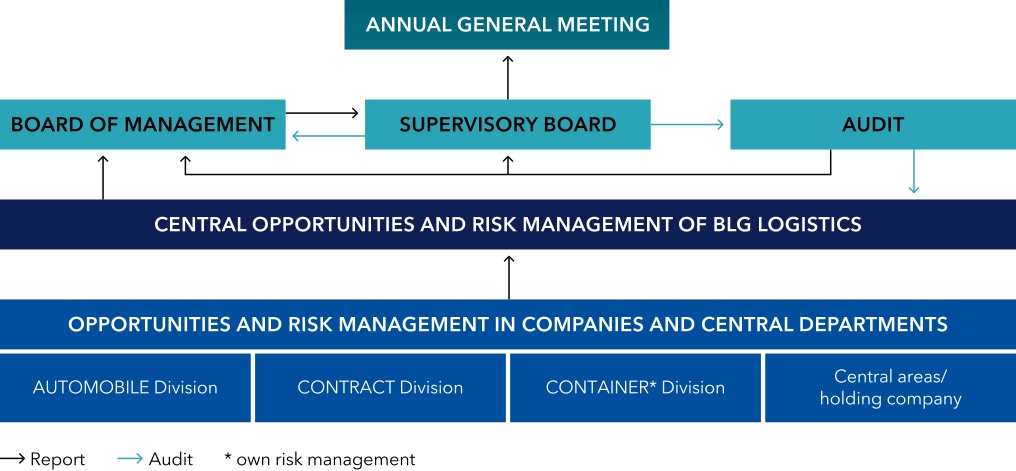
Responsibility and roles in connection with the measures pursuant to Section 91 (2) and (3) AktG are clearly defined in the BLG Group’s organizational charts and specified, communicated and documented in the risk management tool. BLG LOGISTICS ensures that those vested with responsibility meet the required personal and professional criteria and receive regular training from central Risk Management. BLG LOGISTICS ensures that sufficient resources are made available for measures designed to promptly identify, evaluate, control and monitor developments that could jeopardize the organization’s continued existence as a going concern. The main rules on the organizational structure and workflows are documented and made binding.
Risk and opportunity management at BLG LOGISTICS
The risk management organization encompasses the following components:
The organizational structure describes the tasks and responsibilities of all persons responsible for the risk management process and the measures taken to maintain the implemented system at a consistently high level and to communicate developments to those responsible in a structured and systematic manner.
The risk management process is the process of assessing risks by identifying, documenting, analyzing, evaluating, controlling, monitoring, and communicating and reporting risks.
The platform for an effective risk management system is the risk management tool, Which enables risk managers to exchange information flexibly, prepare assessments and consolidate risks.
The divisions submit risk and opportunity reports on the risk management tool on a continuous basis. The risks entered in the risk management tool are evaluated and monitored centrally. The Risk Committee then validates and examines reported risks with regard to their nature and scope. This also involves the option to transfer risks to another risk officer and appoint a person to be in charge of the measures taken. The committee is responsible for general quality assurance, including presenting and commenting on risk exposure. Furthermore, the committee supports the further development of corporate governance (including the integration of the risk management system, internal control system, compliance and internal audit, i.e., integrated GRC). Detailed risk reports are submitted to the Board of Management and the Supervisory Board at least four times a year.
Aims and methods of financial risk management
The principal financial instruments used to finance the Group include non-current loans, current borrowings, lease liabilities, other borrowings, factoring and cash and cash equivalents, including short-term deposits with banks.
Financial risk management is primarily the responsibility of the Treasury department, whose tasks and objectives are described in guidelines adopted by the Board of Management. The central task besides managing liquidity and arranging financing is minimizing financial risks at Group level. This includes preparing and analyzing financing and hedging strategies and contracting hedging instruments.
The material risks for the Group resulting from financial instruments are credit risks (of receivables), counterparty risks, foreign currency risks, liquidity risks and interest rate risks. The Board of Management has adopted a risk management guideline aimed at identifying and monitoring risks from an early stage. At Group level, the current market price risk for all financial instruments is also monitored.
Hedge accounting is applied if derivative financial instruments are used as hedging instruments and the requirements for hedge accounting in accordance with IFRS 9 are met. The objective is to reduce inconsistencies in recognition or measurement arising from gains or losses from a hedging instrument not being credited or charged to the same account in the financial statements as the gains or losses from the hedged risk, for instance. The Group’s accounting policies for derivatives and other disclosures on hedge accounting are presented in note 32 in the “Derivative financial instruments” section.
The company counters the financial risks arising from the dynamics of the current geopolitical situation with a regular risk assessment, from which appropriate measures are derived where necessary. In addition, any effects are taken into account in financial forecasts.
Capital risk management
An important capital management objective for BLG LOGISTICS is to ensure the ability of the company to continue as a going concern in order to provide income to shareholders and to provide other stakeholders with the benefits to which they are entitled. Additional goals are to optimize liquidity security and maintain an optimum capital structure (incl. the company’s equity base) in order over the long term to optimize the costs of capital in general and the refinancing risk in particular.
BLG LOGISTICS monitors its capital on the basis of the equity ratio and other key performance indicators. Assurances have been made to all partner banks with regard to equal treatment and the change-of-control clause.
Internal control system
As the set of all systemically defined controls and monitoring activities in the company, the ICS is designed to safeguard assets, to ensure the security, completeness and reliability of internal and external reporting and to guarantee compliance of all activities with the relevant laws, regulations, ISO standards, internal directives and work instructions. The ICS is embedded in the procedural workflows of BLG LOGISTICS and helps create transparency in the business processes.
By design, the internal control system at BLG LOGISTICS considers all material business processes and goes beyond controls in the accounting process. The non-financial ICS covers topics such as environmental violations, occupational health and safety, and anti-corruption.
The ICS and the elements that contribute to it are regularly the focus of audit activities by the Internal Audit department. These are activities carried out either within the scope of the risk-based annual audit plan or within the scope of audits scheduled during the year at the request of management.