

Global economy
Before the escalation in the Middle East, moderate but uncertain recovery of the global economy was expected for the 2026 financial year. However, the situation continues to be dominated by geopolitical tensions, protectionist tendencies and ongoing volatility in energy and commodity markets. Leading institutions expect global GDP growth to range between 2.4 percent and 3.1 percent. While inflation rates in industrialized countries are approaching the target level of 2 percent, they remain susceptible to fluctuations due to political uncertainty, wars, climate risks and supply constraints. Major central banks are pursuing a cautious normalization of monetary policy, resulting in slightly improved but still restrictive financing conditions for companies and private customers. The currently escalating conflict in the Middle East may lead to higher energy prices and disruptions to our customers’ supply chains.
Europe
Economic conditions in Europe are showing signs of a noticeable recovery but remain fragile, not least because of the conflict in the Middle East. Real GDP growth of 1.3 percent is expected in the eurozone in 2026, supported by public investment, a recovery in private consumption and ongoing digitalization and decarbonization efforts. Inflation in the eurozone is expected to range between 1.7 percent and 2.0 percent. The conflict in the Middle East is currently driving up gasoline and gas prices in particular and may affect the outlook. Other key external risks include rising trade barriers, unexpected market reactions and renewed spikes in energy prices.
Germany
For Germany, a gradual recovery is expected in 2026, reflected in a more stable investment and employment situation. Research institutes forecast GDP growth between 0.9 percent and 1.2 percent, with government transformation and infrastructure programs, as well as a gradually strengthening private consumption, acting as the main drivers. Prior to the outbreak of the current conflict in the Middle East (Iran), the Bundesbank and IMK had expected inflation to settle in a range of 1.8 percent to 2.0 percent. The extent to which these assumptions will materialize will also depend on the duration of the current conflict. The unemployment rate is expected to remain between 5.6 percent and 5.9 percent. Headwinds remain in the form of external economic weakness among key trading partners and lingering protectionist effects, as well as current US tariff policy, unpredictable energy price developments, labor shortages and rising transformation costs – particularly for energy-intensive industries and mid-sized companies.
Conclusion
A cautious recovery and gradual stabilization of the economy had been expected for the 2026 financial year prior to the current escalation in the Middle East. However, the environment continues to be shaped by numerous uncertainties. Key indicators – global GDP growth of 2.4 percent to 3.1 percent, eurozone growth of around 1.3 percent and GDP growth in Germany of 0.9 percent to 1.2 percent – underscore the need for a flexible and risk-aware corporate and economic policy and are likely to be achieved only if the current conflicts are resolved quickly and do not escalate further.
Sources for this section: IMK, IMK report no. 199 (2026); Deutsche Bundesbank: monthly report, January and February 2026 IfW Kiel, Kiel Institute Economic Outlook, No. 128 (2025|Q4) Handelsblatt.de: “Selbst Mini-Aufschwung 2026 wird immer kleiner,” December 11, 2025, accessed February 18, 2026, 4:59 p.m. Tagesschau.de: “Deutsche Wirtschaft 2026 besser, aber in Europa hinter dem Durchschnitt,” November 17, 2025, accessed February 18, 2026, 5:05 p.m.
Logistics sector again faces challenging year
Business climate for logistics service providers
(Source: Bundesvereinigung Logistik e.V.; 2015 = 100 = normal level)
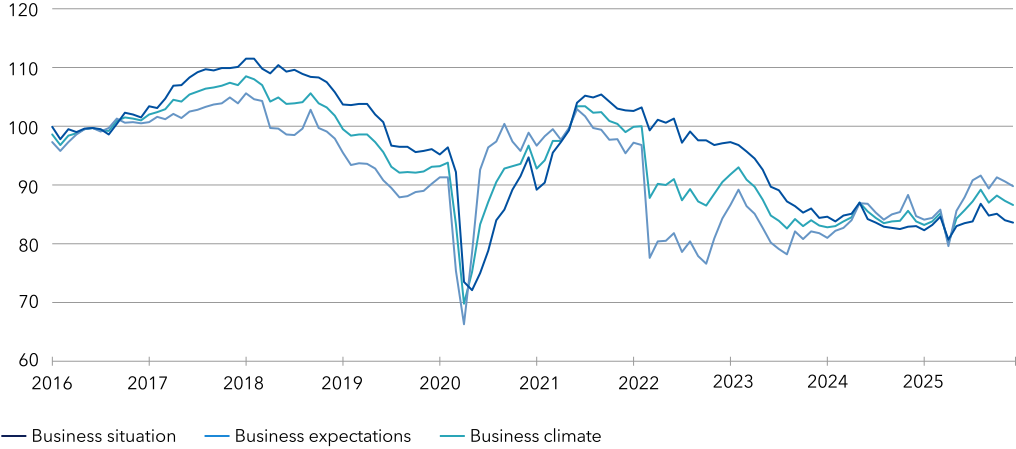
The business climate in Germany’s logistics sector improved slightly toward the end of 2025. However, a noticeable upturn in the logistics sector is not expected in the near term, according to the Logistics Indicator of the Bundesvereinigung Logistik e.V. (BVL). The ifo Institute collects the data for the Logistics Indicator on behalf of the BVL as part of its monthly business surveys.
Despite the slightly positive trend, overall business sentiment in the German logistics industry remained subdued. While business expectations improved moderately, they continued to be weighed down by geopolitical uncertainties, high costs, and structural challenges – particularly in the industrial sector.
The SCI Logistics Barometer at the beginning of 2026 indicates that business sentiment remains cautious. The industry continues to face persistent cost pressures and low willingness to invest. Companies are placing their hopes on stable political conditions and momentum for a sustainable economic recovery.
Revenue development in the German logistics sector
Source: Bundesvereinigung Logistik e.V.
* = Forecast; in EUR bn.
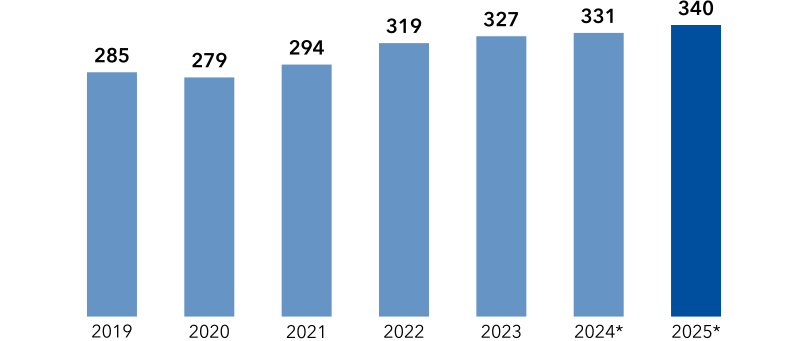
In 2025, the German logistics industry remained subdued overall despite some positive signals. Business-to-customer (B2C) transport continues to be regarded as a growth area.
At the same time, the sector is under significant cost pressure: higher toll charges, increased labor costs and persistently high energy prices have had a noticeable impact on companies and are likely to continue weighing on them in the coming months. The demand for qualified skilled workers remains high and poses structural challenges for many companies.
Despite these difficult conditions, the latest industry indicators – including the BVL Logistics Indicator for the fourth quarter of 2025 and the SCI Logistics Barometer at the beginning of 2026 – paint a cautiously optimistic picture for 2026. Business expectations in particular are brightening slightly. Companies are increasingly investing in sustainable logistics solutions to reduce carbon emissions and are driving forward the adoption of new technologies such as artificial intelligence (AI) and the Internet of Things (IoT). While these developments continue to require significant investment, they also offer opportunities to improve efficiency and strengthen competitiveness in 2026.
Sources for this section: BVL Logistics Indicator, 4th Quarter 2025, including commentary SCI Verkehr, SCI Logistics Barometer, January and February 2026